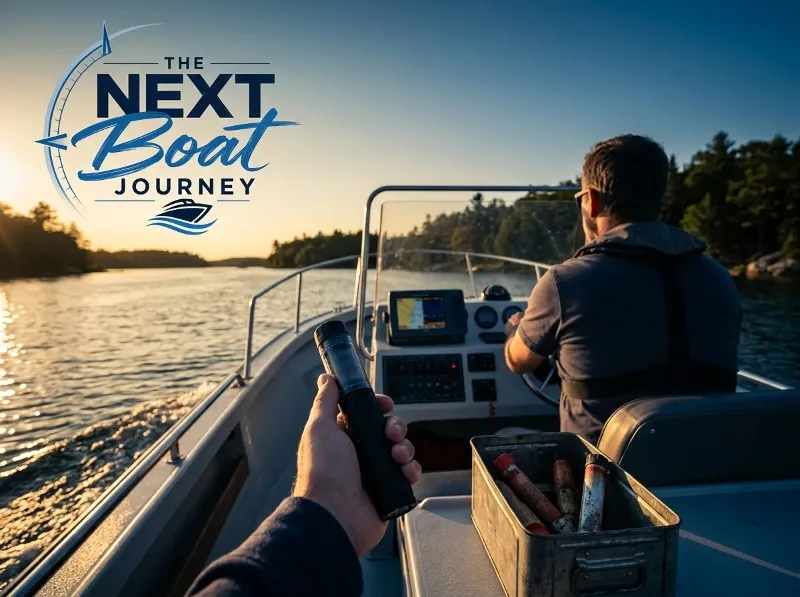
Sirius Signal's Steve explains how electronic distress lights are changing boating safety, why alternatives to flares matter, and what every boater should know.
For decades, recreational boaters have relied on pyrotechnic flares as one of their primary visual distress signals. The technology has a long history. Sirius Signal was created around a simple question. Could there be a safer and more practical way for boaters to signal for help?
On the latest episode of Dock Side Live Radio's The Next Boat Journey, Brian Burns spoke with Steve from Sirius Signal about the company's origins and the problem it set out to solve.
The story goes back to 1979, when the U.S. Coast Guard established specifications for a non-pyrotechnic nighttime visual distress signal for recreational boats. Early attempts missed what the Coast Guard had in mind. An SOS flashlight from the early 1980s was directional and not bright enough.
According to Steve, Sirius Signal's story began in 2014 when CEO Anthony Covelli was approached by Bob Simons, a 30-year Coast Guard Auxiliary member. Simons brought the Coast Guard specifications to Covelli, whose background was in lighting engineering for the automobile industry.
The result was the C-1001, introduced in 2015 as a Coast Guard-approved electronic visual distress signal. The LED light flashes the universal SOS pattern for more than six hours and continues flashing for about 60 hours as the batteries drain. Sirius Signal designed its packages to address multiple safety requirements, including a daytime distress flag and a whistle.
The difference between an electronic signal and a traditional flare goes beyond convenience. A handheld flare burns for 60 to 180 seconds and produces extremely high heat. Someone has to hold it while it is burning. That becomes another problem when a boat is rolling, conditions are deteriorating, or someone aboard is already dealing with an emergency.
An electronic distress light can be activated and handed to another member of the crew while the captain deals with the underlying problem.
Steve also emphasized that Sirius Signal does not view electronic distress lights as a reason to eliminate every other safety device. There is no one device that is perfect for all situations. The goal is to give boaters alternatives and additional tools when something goes wrong.
The Next Boat Journey airs Thursday at 5 PM on Dock Side Live Radio, with encore presentations Saturday and Sunday at 5 PM.
This episode is part of Dock Side Live Radio's ongoing effort to help boaters make better decisions throughout their boating journey, from their first boat to the next one.
Special thanks to our Next Boat Journey Founding Partners: Dockmate, SOS Boat Screens, Big Bumper Company, Let's Go Boating, The Florida Mariner Magazine, Franklin Pillsbury IV and Sirius Signal.
Learn more about Sirius Signal at SiriusSignal.com.